News Epic Games Store

I think he accidentally killed UEFN. Why bother shipping something only in Fortnite when you could ship it to Fortnite, PC, consoles and mobile?

Does this mean they've given up on the EGS and are trying again using Fortnite as their new storefront?
They're going after the Roblox market.
 
  • Toucan
Reactions: lashman
They're going after the Roblox market.
Imagine playing Miliastra Wonderland (Genshin Roblox) via Genshin launched through Fortnite. Lol.
(Assuming Genshin Roblox even gains traction in the west, right now it seems to be big in China mainly, I think?).
 

Developers will have the ability to publish Unity games into Fortnite, one of the world’s largest gaming ecosystems with more than 500 million registered accounts worldwide, and participate in the Fortnite Creator Economy.

There are 500 million Fortnite accounts now. The most recent source I could find showing the number of accounts prior to today's announcement was 400 million back in 2022. (I know there are >900 million Epic accounts, but that includes everything that uses EOS and shoehorns it into other platforms).

Also the announcement indirectly confirms the rumor Fall Guys will be ported into Fortnite. Rocket League will likely get ported at some point as well.

Imagine playing Miliastra Wonderland (Genshin Roblox) via Genshin launched through Fortnite. Lol.
(Assuming Genshin Roblox even gains traction in the west, right now it seems to be big in China mainly, I think?).
Everyone is gunning for that UGC pie. Epic, Roblox, Mihoyo, Rockstar and probably some more companies I'm missing.
 
  • Like
Reactions: thekeats1999
1.webp

The sponsored row in Fortnite is live. It's buried lower than I would have thought and you have to scroll through the home row, a carousel promoting the new Stranger Things map, a list of modes using different IPs and Epic's modes until you reach it.
 
  • Toucan
Reactions: Kyougar and lashman
Screenshot-20251126-172659-Chrome.jpg
 
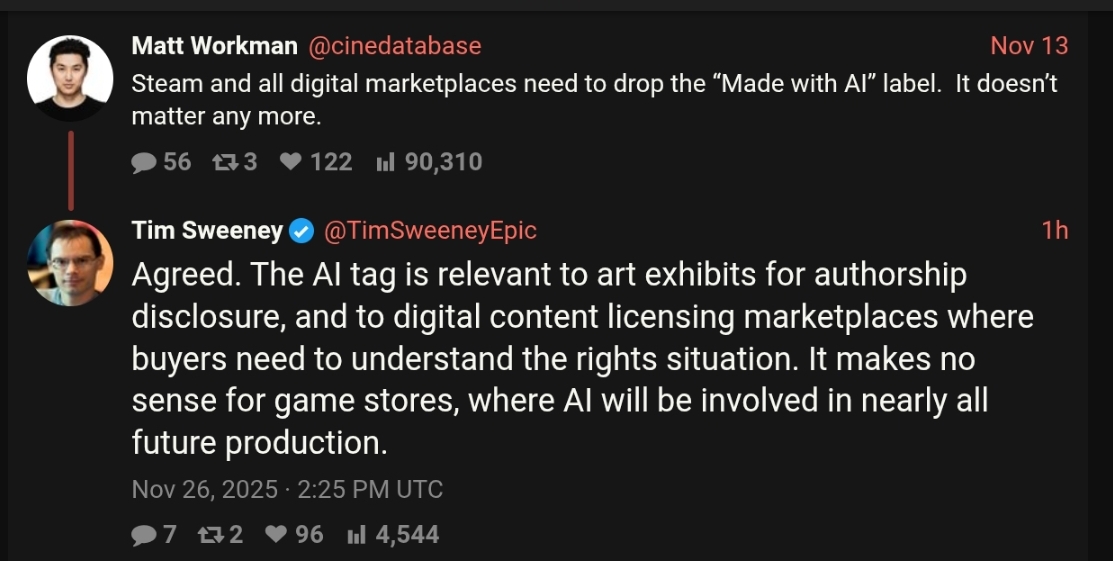
Won't somebody please think of the consumers? Keeping them informed I'd actually bad for them. Thankfully Tim really cares about them

One of the strangest aspects of the whole EGS thing was some developers actively supporting keeping customers in the dark and trying to trick them into buying a game they might not enjoy. Several developers that were posting on Era were in favor of no reviews, no refunds, no performance tests, no forums, basically no ways for the customer to make an informed decision.

I don't know if those opinions were widespread among developers or if those specific ones just drank Tim Sweeney's kool aid. It was pretty shocking to me that no one seemed to realize how important building the customer's trust is.
 
I'm very AI-skeptic, but I don't think Tim's take is incorrect here.

Nearly all code produced now has AI-derived aspects.
I personally try to avoid using straight-up generated code, and I generally use AI as an alternative to searching on Stack Overflow (also thanks to the fact that I'm experienced enough to tell when an answer is broken, both in a GPT chat or on Stack Overflow).

Should I disclose my AI usage? And what if I used some generated code somewhere? Is it that much different from an artist, like, generating some background detail instead of drawing it manually? I honestly don't know, but virtually everyone is already using AI one way or the other.
 
  • Sad
  • This!
Reactions: xinek and lashman
I'm very AI-skeptic, but I don't think Tim's take is incorrect here.

Nearly all code produced now has AI-derived aspects.
I personally try to avoid using straight-up generated code, and I generally use AI as an alternative to searching on Stack Overflow (also thanks to the fact that I'm experienced enough to tell when an answer is broken, both in a GPT chat or on Stack Overflow).

Should I disclose my AI usage? And what if I used some generated code somewhere? Is it that much different from an artist, like, generating some background detail instead of drawing it manually? I honestly don't know, but virtually everyone is already using AI one way or the other.
Yeah when it comes to code I dont know what degree of disclosure should be applied. As you I use AI instead of googling code related stuff. And to find bugs AI can be very helpful.

Weirdly for anything other than code, I would like to know if AI was used. I just assume that for the code AI was used to some degree.
 
I'm like that too, and it makes me so uncomfortable!
Is it personal bias? Is it because we are used to think of visual and sound as art (so worthier of human origin) whereas code is just a tool?
Kind of? I think we are so used to using code that we haven't written every line of, everything from getting code from googling to something like bootstraps, CMSes, libraries and so on.
 
  • Like
Reactions: lashman
One of the strangest aspects of the whole EGS thing was some developers actively supporting keeping customers in the dark and trying to trick them into buying a game they might not enjoy. Several developers that were posting on Era were in favor of no reviews, no refunds, no performance tests, no forums, basically no ways for the customer to make an informed decision.

I don't know if those opinions were widespread among developers or if those specific ones just drank Tim Sweeney's kool aid. It was pretty shocking to me that no one seemed to realize how important building the customer's trust is.
1.webp

It comes from the top. He's shown active disdain for users.

Also re; the AI disclosures. I reread Valve's blog post and they mention AI generated code, but I think the point of contention for most people are AI art and music assets. Maybe Valve should revise it to include those, but I'm not a programmer so I won't pretend like I know what I'm talking about.
 
View attachment 602

It comes from the top. He's shown active disdain for users.

Also re; the AI disclosures. I reread Valve's blog post and they mention AI generated code, but I think the point of contention for most people are AI art and music assets. Maybe Valve should revise it to include those, but I'm not a programmer so I won't pretend like I know what I'm talking about.
I’ve tried to see exactly what steam means, but all they say is content. I guess that means everything. But to what degree? Bug testing? Grammar check on text?
 
FWIW I appreciate the conversation happening right now, e.g. how the disclaimer should be treated as a "list of allergens" for software.

I still think that AI is used at all levels already, and we are only annoyed when it's visible. Which is fair, I guess, but it really begs for more detailed information.

Again I can't say how biased I am, but surely using AI as a search engine is different than generating an artwork, which is different than only changing a detail in the background, or upscaling an image, etc.

I guess I find this whole thing fascinating because we (enthusiasts, industry workers, etc.) are in the very middle of one of the biggest paradigm shifts in our lives, and nobody really knows how to handle it.
 
Another consideration is how the disclaimer fundamentally attributes all the responsibility to the end-user of the AI, and not on who should regulate and control the AI in the first place.

Perhaps it would me more interesting if the disclaimer would say "this game uses an AI model trained only on authorized or open source material" (which might be ethically correct) vs "this game uses a model trained on copyrighted material so the main character might have the face of george clooney and the voice of darth vader".
 

Epic says 10.5 million people attended the end-of-chapter event even though the in-game counter was 9.4 million. Still down from the 11.6 million in 2023 and the 14.3 million last year.

"The Epic Store is the second largest storefront on PC"

cf9a4e6c6d2b60672d5fc0aa6b4d8113.jpg
I rolled my eyes when he compared Steam to Facebook and EGS to Tiktok and had the nerve to say the average game on Steam makes $0 and it's awful for discoverability.
 
FWIW I appreciate the conversation happening right now, e.g. how the disclaimer should be treated as a "list of allergens" for software.

I still think that AI is used at all levels already, and we are only annoyed when it's visible. Which is fair, I guess, but it really begs for more detailed information.

Again I can't say how biased I am, but surely using AI as a search engine is different than generating an artwork, which is different than only changing a detail in the background, or upscaling an image, etc.

I guess I find this whole thing fascinating because we (enthusiasts, industry workers, etc.) are in the very middle of one of the biggest paradigm shifts in our lives, and nobody really knows how to handle it.

Yea Tim is a nutjob and he's saying what he's saying for his own benefit, but he's kind of right when you look at it objectively. Many people against AI still think of it being used to create static art with prompts while bypassing artists or for voice acting without paying actors, but honestly it's gone a lot further than that already. For example, a whole lot of programmers now use tools like Claude while writing their code. Now that is also a form of AI use and technically it would require disclosure on Steam. There are people who would see the AI disclosure and immediately disregard the game but do they understand how it was used? Are they actually against programmers using those tools to write code faster?

We all know the industry is in crisis right now. Games are taking longer to make and causing budgets to balloon to the point where they need unrealistic unit sales to make money. The result is that everyone is now trying to make a GAAS game, entire genres (immersive sims) are considered poison and generally there's a lack of creativity and risk taking in the AAA space. People often say that the solution is to make smaller games with smaller scope and worse graphics and so on but the part they don't say is that they also want those games to be cheaper. So if a game costs less to make but also has to sell for less per copy then you still need to sell a ton of units to make back your budget. And the truth is, the wider market will not accept those scaled back games. If the next God of War comes out and looks like the PS3 God of War games it's going to flop. People will point to games like Hollow Knight, Hades 2 or other indie successes but those are lightning in a bottle outliers. Like yeah, the success of Arc Raiders or Expedition 33 is proof that you can succeed with smaller budgets and lower prices and all you need to do is make a GOTY every time. Sounds simple enough, right?

Personally, I want more automation in game creation. I'm at the age where having to wait 6-8-10 years for a studio I like to make their next game is too long for me. Given their current speed of development, I can count on one hand how many more GTA games will release while I'm alive. Let's say a company is creating a large open world game. If they follow the Ubisoft or Rockstar approach it will take thousands of people several years to make that open world. Personally, I don't care if that yellow flower next to that small rock behind the tree was placed by hand or not. If there's a way to automate it then go right ahead. Reuse assets wherever possible to cut down on asset creation. The upside to this will be that games will be made faster, they'll cost less to make and (hopefully) won't require companies to bet their entire future on the next product. An actual, sustainable industry which might even go back to taking risks. The downside will be that they will employ only 1000 people instead of 4000 per production.

In any case, we can discuss and speculate on this matter as much as we want but the industry is already moving in that direction anyway. People will need to accept that AI is more than chatgpt hallucinating stupid shit or people creating pictures with midjourney prompts. Epic is preparing to use incorporate AI into Unreal engine 5 and most certainly 6. What will the rules be for AI disclosure if a studio doesn't use AI to create their game but the tools they use to create the game were made with AI?
 
II wanted to provide some perspective on using generative MLLs for creating code, as I work as a maintainer on an open-source software project, so I've investigated the Subject several times.

I've observer several issues that don't seem immediately solvable:
- For established projects with a sizeable codebase, changes made with AI tend to be quite big, As AI tends to add instead of deleting or changing code; and the AI operator doesn't know whether the code is correct or not. This means that maintainers don't know whether the code is obviously correct and have to spend co sifwrablw effort reviewing these changes: it increases maintenance burden while possibly introducing subtle bugs because nobody has thought of edge cases.

- The origin of the generated code is unknown. For projects that don't release code this might be well masked, but for open-source project this is not possible, and open the projects and companies that contribute to it to being sued for copyright infringement. Some projects have long thought about contributors that add code they don't have the right of by forcing them to certify that all changes source of origin is known. This means AI-generated code can't be introduced.

In shot, AI-generated code is a big liability, which opens companies and projects to lawsuits and make long-term software project more difficult to maintain.

I'm surprised that the consensus here is to simply accept these risks (I'd say even ignore) these risks. maybe for game-making is less of project because there's a lot of ad-hoc code. But the maintenance burden will still be felt in the long run if it's allowed in engines and software libraries, and this is a risk unique to code.


To come back to disclosures on generative AI, I think they are needed because how damaging to culture and the environment can be. Thrdr disclosures need to be made granular because not all uses of AI have the same impact, (was the AI trained with public domain works only?), but it absolutely needs to be there.

This attitude of accepting that AI I'd pervasive, "just embrace it" remind me of a lot about using Linux as a gaming platform over the years: I've had to let go of many games because they didn't work on it (and many still don't), but I think I would have been worse off if I hadn't made the switch.
 
To add to undu's brilliant explanation, we only have to look at Windows to see how bad AI coding is.

I mean, Windows has always been shit, but there's been a recent spate of incidents where it's been even more terrible than usual.

We know Microsoft is pushing AI hard to their staff. They recently rolled out features for their platform which tells system admins how much each employee is using AI, and they almost certainly made these features because they wanted them internally.

There's a pressure to use AI, and Nadella says 30% of Microsoft's code is AI (though, given how reliant he's become on Copilot, that could be some nonsense he's huffed from one of his AI assistants), so it's safe to assume AI code is actively making Windows worse. When the bubble bursts and the hype dies down, organisations will have a legacy of "AI debt" that will take a lot more resource to find and clean up than time and money saved in the present to generate it.

A big part of AI's problem is for complex stuff (like, say, a video game) is it's extremely low quality. But the kinds of people making the decisions on AI rollout don't know what "good" looks like.

And those same people also want to muddy the waters of what is and isn't AI, so in the future people won't even be able to audit AI-tagged code to find the dross.

I'm seeing the same problem at work: people are writing important policy and legal content using AI, and no one's tagging or flagging it as AI generated. When the chickens come home to roost, all that time saved will be undone when a team of lawyers and policy experts need to comb every document and site on our intranet for bullshit.

There is a far simpler solution to games taking 7-8 years to make: don't make AAA games to feed the meat grinder.

The industry has gone down this high spec rabbit hole and is actively killing itself. Hardware isn't getting cheaper, games aren't getting cheaper. Audiences are being alienated from gaming because the push for high specs is basically starving the platform. AI isn't going to solve any of these problems.

To be sustainable, the games industry (and more broadly speaking the tech industry) has to act sustainably. A quick fix vibe coding app - that has never been profitable, is driving up consumer electronic prices and destroying the planet - is only going to make things worse in every conceivable way.
 
Last edited:
In shot, AI-generated code is a big liability, which opens companies and projects to lawsuits and make long-term software project more difficult to maintain.

I'm surprised that the consensus here is to simply accept these risks (I'd say even ignore) these risks. maybe for game-making is less of project because there's a lot of ad-hoc code. But the maintenance burden will still be felt in the long run if it's allowed in engines and software libraries, and this is a risk unique to code.

I think this is what everyone who uses AI tools for coding support (and also everyone whose profession intersects with AI) is trying to figure out right now. First of all, the importance of the code/work will determine how AI is used. If you're a programmer who works on your nation's space program or for the defence ministry or Formula 1 or something important then you're not using AI at all. But if you're the person who maintains the website for your state government's fisheries department then I don't think it matters much at all. For video games, no serious commercial concern is going to "vibe code and push to production". It's just not going to happen. Instead, people are being asked how they can use these tools to improve efficiency. I think a sort of middle ground needs to be found for these tools... as a simplistic example, you can ask AI to create a function but then disallow the programmer from just copy-pasting that function into the code. The same goes for asset creation, world design, animation, CGI and just about every part of the creation of a game. The idea being that you use these tools to do work more efficiently instead of using them as shortcuts and compromising the quality. That is what organizations need to figure out and enforce.

There is a far simpler solution to games taking 7-8 years to make: don't make AAA games to feed the meat grinder.

You haven't actually offered a solution here. "Just don't do what you're doing" is not a solution at all. What would you have them do instead? First of all, the industry will shrink dramatically if they stop making AAA games. I'd say a 75% headcount reduction in big studios because you don't need 1000 people to make non-AAA games. Secondly, where does this idea come from that the market doesn't want AAA games? A quick look at the Steam global top 20 list shows that there's only one game (Dispatch) that isn't a AAA/multiplayer/live service game. This is what the market wants and without knowing a single point of data, I would guess that these games make up >80% of non mobile gaming revenue. So the question changes to how to make AAA games sustainable to fulfill the demand. What can be done so that the life of a studio doesn't hang in the balance after every production. This is where I would not mind the use of automation and AI tools if they are done well.

Personally, and somewhat selfishly, I would prefer that games be much shorter than they are these days. There are so many games I want to play that I just can't get myself to start because of how long they are. I own something like 6-8 copies of Persona 5 and Royal across various platforms and I've wanted to play it ever since it came out 7 years ago but the idea of playing a 120 hour game is very daunting for me at this point in my life. I can make myself play maybe one 100+ hour game a year, if that. I've still not gotten around to playing games like KCD2 or BG3 that I desperately want to because of the length. So I'd be very happy if games were shorter and that would have the benefit of smaller budgets and production cycles as well. Unfortunately it does not seem to be a widely shared opinion given that the industry keeps making bigger games.
 
A quick look at the Steam global top 20 list shows that there's only one game (Dispatch) that isn't a AAA/multiplayer/live service game.
Sale periods aren't a good indicator if years old AAA games are sold at indie prices. That's not what any publishers wanna sell their games at launch. That goes to their marketing budget as well, clearly that can lead to better sales so maybe they could instead share that budget to many less costly games that might in turn sell better. Maybe make it about sustaining many smaller studios/teams from whatever amount of success they can get than total mega corp profits everyone failing to deliver - when there's really no way to guarantee that delivery (like are marketing folks asked to "just make a viral video") - gets the axe.
So the question changes to how to make AAA games sustainable to fulfill the demand.
It's not gamers whining about AAA making them unsustainable, we wouldn't care to have the conversation at all if it wasn't shown to be from the publisher and developer side, so if they really aren't then there's not enough demand for them so no reason to try and fulfill it. Plenty non AAA games are mega sellers on their level too so there's plenty of demand for non AAA games too. Even Nintendo has thrived on them. Maybe try that approach, not because every developer can do a Nintendo or indie hit but because when they fail the loss won't be as devastating, the next try can be sooner, so it's more sustainable. I don't mind gaas, I don't but folks like multiplayer etc., but everyone gunning for that also apparently hasn't been sustainable so it too doesn't have to use AAA budgets/risks.

So if AI is about cutting cost to deliver that faux AAA deal why not first try cutting the cost but not doing it with AI and seeing how that goes? If AI does cut costs for AAA and makes it more sustainable in that way then what that really means it that it does cut the manhours needed and therefor will also lead to a shrinking, even if that shrinking won't be visible in the game output and mega corp profits but "only" in terms of the jobs slashed so where's the general benefit there?
 
Last edited:
  • Like
Reactions: Nebulys and lashman
Okay well I ignored everything on sale and checked the top 20 games again. It's still 16/20 that are AAA/live service or multiplayer. The remaining 4 are Dispatch, ETS 2 DLC (which I would argue is essentially a live service), an indie co-op multiplayer game and a Risk of Rain 2 DLC. Whatever one's perception of demand, it is an objective fact that these are the games that make the lion's share of all revenue in the 'core' gaming space. Mobile is on a whole other planet but we're not talking about those here.

Okay you edited your post to expand your thoughts while I was posting so I'll add to mine as well.

I don't think we can use Nintendo as a benchmark for anything. Nintendo makes great games but they also operate in a country with lower dev costs, a different kind of work culture and most importantly, they have a captive audience. They can get away with doing things that nobody else in the industry can. I've been playing the new Pokemon game and it's fun, but it has very low production values and no voice acting. No other company in the industry can release a game like that for $70 and sell 20 million copies like Nintendo will.

Likewise, when you say plenty of non AAA games are mega sellers, what does that mean exactly? What percentage of the total gaming revenue do they constitute? Is the demand high enough to sustain everyone working in the games industry right now? Let's say we get one megahit indie/small game per week on Steam. That's 50 games a year out of 8000 that release on the platform. Let's say there are only 2000 'real' games out of those 8000. A 5% hit ratio?

I don't know why you're pushing back on the idea that AAA games are the most popular games around. They get the most players and they earn the most money. They are literally, by definition, what the market demands the most from this industry. It doesn't make sense to say that the industry should just not make those and instead make games which make much less money (overall) and have a smaller addressable audience. I'm not even saying anything controversial here am I?
 
Last edited:
  • Like
Reactions: lashman
Okay well I ignored everything on sale and checked the top 20 games again. It's still 16/20 that are AAA/live service or multiplayer.
But then you've cut every indie game cos they're constantly on sale, Idk man, try to find a better way to gauge this, check charts before the sale or wait after the holidays. Or not, I dunno what even the point is, I didn't really try to claim a random indie game will have the same exact reach and profit (since they're generally way cheaper so even the same amount of sales won't top the revenue charts) as the best mega marketed AAA games (even if some do, maybe not this week or whatever but clearly we all know games like Minecraft achieved this as did many Nintendo games that don't follow the same AAA path though they certainly aren't like indie games either), that wasn't the point, so even if that's right that doesn't mean the people buying these AAA would stop gaming altogether if they only had non AAA alternatives to play and the companies can't target that specific audience in all other ways they do except the actual AAA budget, it could also be that they buy more games targeted at their preferences and play them for less time each making more of them sustainable in the long run and the failures less catastrophic than all flocking to the same big ones and playing until their sequels so that everyone fights for the same audience and the fails get axed.

And no, chart toppers aren't necessarily the most revenue. It's like people keep saying only Nintendo games sell on Nintendo platforms and yes they dominate every top 10, 20, 30, 50 chart, but Switch for example has sold about 1.5 billion retail games and all of Nintendo's games added up are a few hundred millions of that so then which games really brought the most money on the platform, Nintendo games, or all the rest even if they individually don't top any chart and what's best, for all the money to go to one corp or to be distributed to so many others? It's not like my argument has been yes, the status quo of big companies outspending everyone else and making the most profits and then complaining said profits still aren't enough so they need to cut costs (ie jobs) at, er, all costs, with AI or whatever other practices they can come up with to remain at the top is the status quo we should be striving to maintain, lol. Idk why you single out Nintendo as being in a cheaper country, all companies outsource to varying degrees and many of the big AAA corps are in Japan just like Nintendo which still isn't following AAA trends (but again is also far from indie too), when did this become only about US or north western EU mega corps that should keep winning?

I never said all indie games or all good games do well either, so hey, maybe we do need the industry to shrink, but hopefully not just for mega corps' winnings but also it's not like indies are the bloat and who am I to tell any indie with a day job that wants to also create and publish a game not to because it adds up to unfavorable stats or whatever, it's up to them to gauge the risks and how much they put in the side gig and when they fail they don't cut 1000 jobs either.
 
Last edited:
  • Like
Reactions: Nebulys and lashman
I would argue unsustainable game development has been pushed by companies with the biggest wallets to make their competition go bankrupt. Big publishers like EA and Ubisoft were able to outspending smaller publishers and developers, and release more appealing games with better graphics, and sold them at the same price as the "mid tier" releases that were more sustainable but ultimately "inferior".

Unfortunately they can no longer control the monster they've created.

AAA(A) games dominate the market in terms of revenue and sales, but even with that domination they are unsustainable to the point that people are talking about $100 games. It's absolute lunacy. And you can count on one hand how many you get a year these days - it's absolute madness.

The dial needs to be turned back. It's completely unsustainable because the audience isn't growing, but their hunger (and expectation) for bigger and bigger games seems to be growing at an exponential rate. Every time I see someone on forums saying they can't wait for next-gen, when we've not even had a proper generation defining game on PS5/Series X just makes me despair. GTA skipped a whole generation. So many companies went bust, or IP got cancelled. I reckon we could go all the way to 2030 and not need a new console generation, given how minuscule the next-gen jump is going to be if it releases in 2027 as predicted.

Alas, Sony will pump out new hardware. And there's going to be so much handwringing from the spec arms race audience next-gen when the PS6 is underpowered or a small jump from PS5, or that developers can't make the most of it (and continue to release cross-gen games from PS4 onwards) because the whole industry (including its customers) has reached such insane levels of stupidity.

And if we tie it back to the original assertion: AI isn't going to solve the problem of long development times; it's going to mean shittier games that take even longer to release because its outputs are terrible. The only way to bring development times back down to Earth is to make smaller and cheaper games. It really is that simple.
 
Come on man, what are we doing here?

It's not fair to count AAA games when they're discounted and it's also not fair to exclude indie games because they're discounted?

Minecraft made more money than many AAA games. The bestselling game of all time is your benchmark example for why AAA are less popular?

If the entire industry simultaneously, magically stopped making AAA games then gamers would have no choice but to move to non AAA games because they wouldn't stop gaming entirely. And then demand for non AAA games will beat out demand for AAA??

I'm just saying that live service games and high budget AAA games and multiplayer games have the most players and make the most amount of money. Is that really a controversial thing to say?
 
AAA gaming is just like gacha/gaas: something that has the potential of having big, massive returns
But just like gacha/gaas it's also something that has a clear ceiling, especially as money keeps being a problem. Hell, even CoD is struggling because games like Battlefield or Arc Raiders "exist" in the same space and are monopolizing people's attention
Now, I don't really care what a big company does. It's their money, it's their investors, it's their employees. Who am I to say what they can do or not? The market will speak in the end and games will continue to exist
My problem is companies, both big but unfortunately even smaller ones, are so "ingrained" in this AAA/gaas mentality they abandon all reasoning when making games like these, and so they keep investing, they keep hiring, they keep spending, they keep working even on ideas that everyone could see they're bad (like Suicide Squad) or will never in any universe recover their budget (like who knows how many games in 2025 alone, hell in the last 5 months alone like FTC, VtMB2 and even fucking Borderlands 4 and the last one sold "a lot" so what insane budget did it have?) The "market" has been pretty damn clear in the last years and it's obvious there is a market cap that nothing can break, so going all "it's all right, it will be worth in the end" or "we're insert big name here so we will make bank even if we reboot the whole game 4 times" and the worst one "we have no experience nor the budget to do a game like this, but since it's guaranteed money we will still do it and spend a lot"
When someone like me says "just don't make these crazy AAA games bro" I don't mean just make the lowest budget possible thing, I mean "make a reasonable game". There are many "reasonable" games released this year alone. Clair Obscur is not a low budget game: it's a 50 bucks game (which all right, it's actually "cheap" compared to where AAA is going) with good (not perfect) graphics, and with 2 full dub tracks and supporting 12 languages. The vast majority of players will look at its screenshot and still think "damn, this looks AAA". It's also a game that didn't require half a billion to be created, that doesn't require a 5090 with upscaling to run good, and in a genre that is popular but doesn't have lots of competition either because it isn't percieved as the best performing one. And of course it's only 50 bucks
Kingdom Come Deliverance II is the same. It's not a cheap game, but it's still "reasonable" enough. The problem is how Ubisoft suddenly decides to do a "triple A" Prince of Persia metroidvania with full voice acting, motion captured scenes, big lenght, and then trying to sell it at full AAA price. That's the problem. Remedy making a terrible gaas it's a problem. Microsoft trying to sell a bunch of games that absolutely don't deserve to cost that much at 80 bucks is a problem. Bioware wasting 6 years on a failed gaas, then trying to make the new Dragon Age a gaas too, then salvaging that gaas DA into a new RPG game but still keeping as many things they already did for its gaas version (because remaking it from scratch again would be unthinkable even for these crazed publishers) is a problem. Games getting bigger and bigger budgets because "don't worry, the next breakthrough that will finally break the videogame industry ceiling is coming soon" is a problem
Yes, I like AAA games as much as the next guy. Hell those games are some of the few that get consistently translated in italian at this point so of course I'm fine with them. Just... don't waste time and money chasing an obviously bad idea. Make "reasonable" games. Even if a game requires 5 years don't reboot them endlessly or try to change them just to chase something popular. Focus on something and believe in it, and most of all understand the market. Don't make a 2d top down shoot-em-up with a 400 million budget costing 80 bucks because that game would be lucky to even sell 10 copies

And since this whole discussion started with AI, well I don't know what to add to that. I don't "hate" AI like others, but as it currently stand AI made products just suck. AI art looks bad and samey, AI dubs make games like Chaos Wars feel like oscar winning performances, AI code maybe works but is also inefficient. You want to be cheap and use AI? Who am I to tell you off. But if you want to be cheap don't expect potential buyers to also not be cheap and buy something else if your product isn't up to snuff (example: Clair Obscur. It had AI art as "texture placeholders" at launch, but the game itself was still good)
Companies invested too much money on AI, just like they invested too much money on other "revolutionary" features in the past. And just like the other times they just want to recoup that money as soon as possible, even if the thing itself is still way in its infancy and basically impossible to use on that scale

 
  • Like
Reactions: Nebulys and lashman